
Abstract: Inequalities are more than just constraints; they are powerful tools for solving fundamental mathematical problems. This post explores the isoperimetric inequality and its role in proving that the circle has the optimal area-to-perimeter ratio. We also see how a method of proof involving mass distributions and their transport unifies a vast family of inequalities in geometry and analysis.
Mathematics is commonly associated with deriving and solving equations. However, despite appearing less precise, inequalities can be equally as powerful, particularly in the fields of geometry and analysis.
The isoperimetric problem is a geometric problem that dates back to antiquity. It can be stated as follows: For a given perimeter, find the closed curve on a plane which encloses the greatest area. Since this problem involves finding a geometric object, it may appear unrelated to inequalities, which compare two numbers. However, this view misses a key aspect of inequalities.
Let’s consider a fundamental inequality, , where is any real number. Notice that if we replaced the 0 with a slightly larger number, such as 0.1, the inequality would no longer hold. In other words, the inequality is sharp, meaning that the constant is optimal and there are specific conditions under which the inequality attains equality. So, our example inequality conveys two separate pieces of information:
- The square of a number is non-negative
- If the square of a number is zero, the number must be zero
We can apply this way of thinking to solve the isoperimetric problem. Consider the isoperimetric inequality on a plane: , where is the area enclosed by the curve and is the perimeter of the curve. Put simply, for a given perimeter, the area enclosed by a closed curve with that perimeter is at most some constant derived from the perimeter. This means that the closed curves of greatest area which we are attempting to find are precisely those which satisfy the equality condition of the isoperimetric inequality. Since we can prove that the isoperimetric inequality achieves equality when the closed curve is a circle, the solution to the isoperimetric problem is the circle.
A key method used in the proof of the isoperimetric inequality is optimal transport. Suppose you are trying to move a pile of rubble (“déblais”) to an excavation (“remblais”) with the minimal amount of work. In the theory of optimal transport, this problem is known as the Monge formulation, and, under certain technical assumptions, a solution exists in the form of a map describing where each particle in the rubble needs to be transported to in the excavation. The isoperimetric inequality on a plane can be proved by considering the optimal transport map from a uniform distribution with arbitrary shape (source distribution) to a uniform distribution in the shape of a circle but with the same total mass (target distribution). The proof is completed by applying an inequality which holds locally at each point in addition to some standard results from integration theory.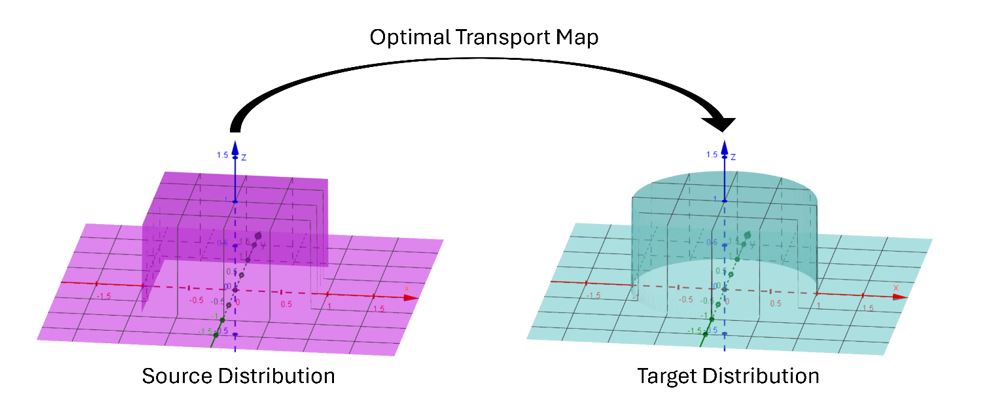
In this proof of the isoperimetric inequality, we made specific choices of the source and target distributions and the inequality which holds locally. By varying these parameters, we can derive an entire family of related inequalities, with applications across geometry and analysis. My project investigated the connections between these inequalities through the lens of optimal transport.
Vinnie Ng
The University of Sydney